This is a hybrid lecture and will be held both in-person and on Zoom.
The lecture will take place at the Harvard Museum of the Ancient Near East, Room 201 at 2:00 p.m.
Address: 6 Divinity Ave, Cambridge, MA 02138,
or you can find it here.
Alternatively, you can catch this talk online by registering on Zoom. here.
This lecture is open to all of our members and we hope to see you there!
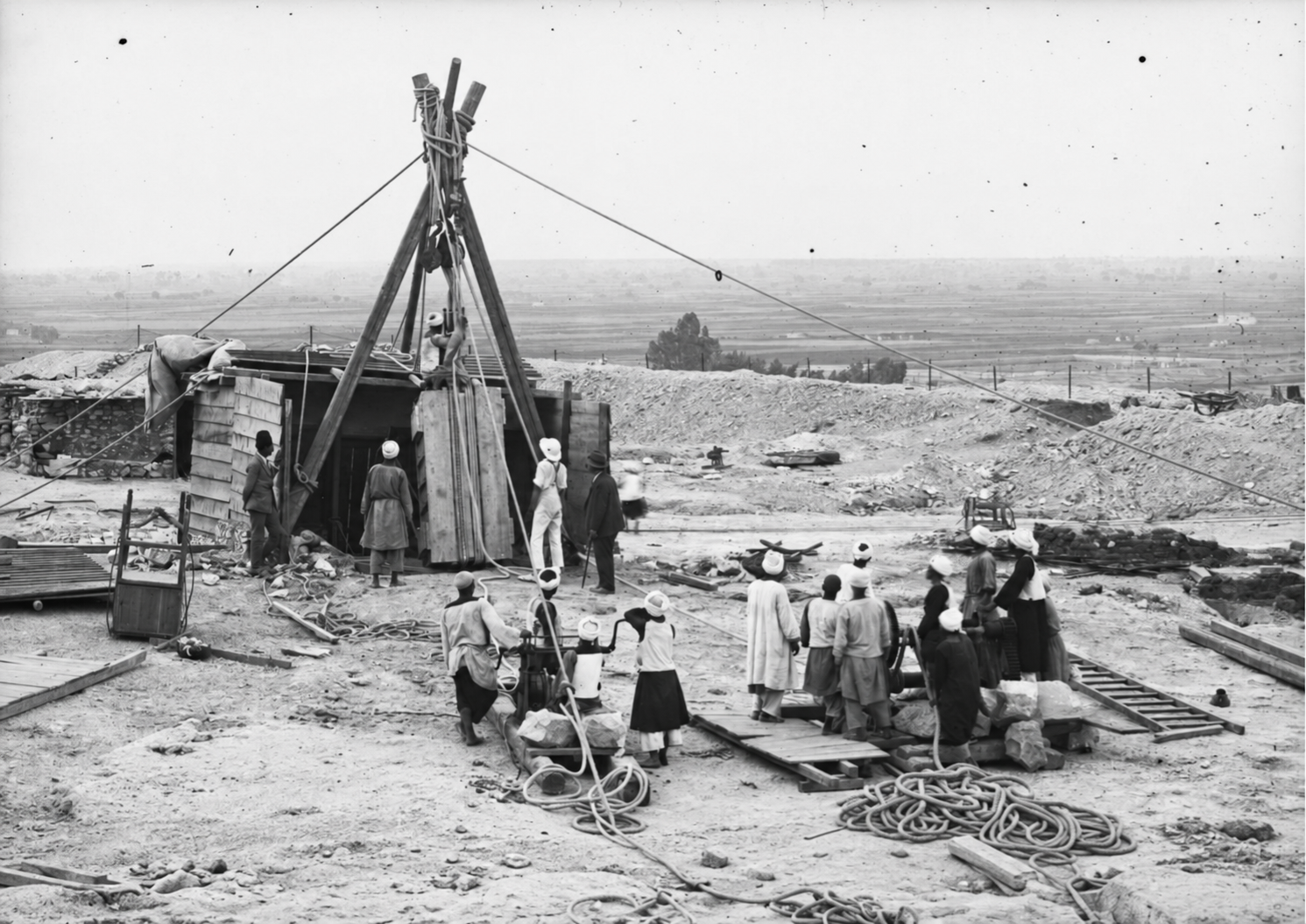
Abstract: In February 1925, the Egyptian team members of the Harvard University–Boston Museum of Fine Arts (HU–MFA) Expedition spotted the plaster blockage covering the so-called shaft ‘G 7000 X’, just east of the Great Pyramid. This would later be identified as the burial shaft containing the royal assemblage of Queen Hetepheres I, wife of King Snefru and mother of King Khufu. Since the discovery, the publications of George Reisner (1867–1942) and the English diaries written by the Western members of the HU–MFA Expedition served as the principal sources for study and narration on the discovery of Hetepheres I. In 2006, the Arabic counterpart of the HU–MFA Expedition English diaries, stored for decades in the home of the Diraz descendants (the family of the Egyptian reises who authored the Arabic diaries), was rediscovered and made available to the scientific community.
Drawing on the Arabic Excavation Archive from Quft, this paper aims to give a voice to the Egyptian reises and explores their contribution to the discovery, documentation, and interpretation of one of the greatest discoveries ever made on the Giza Plateau.
Speaker Bio: Mostafa Ismail Tolba is an Egyptian Egyptologist, field archaeologist, and researcher whose interests include archival collections, ancient Egyptian language, and environmental archaeology. Tolba is currently a PhD Candidate in Ancient Languages and Texts (ALT) at the Free University of Berlin. His doctoral research focuses on digital epigraphic documentation alongside the palaeographical and philological study of the funerary texts in the 26th Dynasty Tomb of Tjanenhebu in Saqqara. From August 2026 to January 2027, Tolba serves as a Visiting Fellow in the Department of Near Eastern Languages and Civilisations at Harvard.
Tolba earned a Bachelor's degree in Egyptology (Very Good with Honours) from the Faculty of Archaeology at Cairo University (2012–2016), receiving the annual Excellence Student Award throughout his undergraduate studies. He later completed a Master's degree in Environmental Archaeology (Grade: Excellent) at Cairo University, offered in collaboration with the University of Cologne (2016–2023).
Tolba’s professional career integrates archival preservation, digital humanities, and academic research: Since Jan. 2023, he has served as an Egyptologist at the Arabic Excavation Archive from Quft, examining the Arabic diaries of the Harvard University–Boston Museum of Fine Arts excavations in Egypt and Sudan (1913–1947). From May 2019 – May 2024, he worked as an Archive Team Member at the German Archaeological Institute in Cairo (DAIK), focusing extensively on historical collections including the archive of Egyptian archaeologist Ahmed Fakhry. Between 2020 and 2022, Mostafa also held roles as a Research Assistant at the Zahi Hawass Center of Egyptology, and as a Teaching Assistant for the Zahi Hawass Egyptology Diploma at the International Digital University.